
Dumitru Potok Project, Eastern Serbia
The analysis of Dundee Precious Metals Dumitru Potok Project in Eastern Serbia is based on Stormlands Mining’s independent modelling using publicly available technical information, including the NI 43-101 Technical Report and Mineral Resource Estimate January 2026.
Introduction
Stormlands Mining’s independent analysis of the Dumitru Potok Project in Eastern Serbia shows how a publicly available NI 43-101 Mineral Resource Estimate can be converted into an illustrative economic valuation model, even where no economic analysis has been published.
This is the central difference between the Dumitru Potok case study and many later-stage project case studies. The Dumitru Potok technical report provides a Mineral Resource Estimate for the Dumitru Potok, Frasen and Rakita North prospects.
Stormlands has used that public technical information as the foundation for an illustrative valuation model, showing how dynamic modelling can help teams understand the possible economic behaviour of a project before a formal economic study is available. The purpose is not to replace a PEA, and the outputs should not be read as formal project economics.
Project NPV
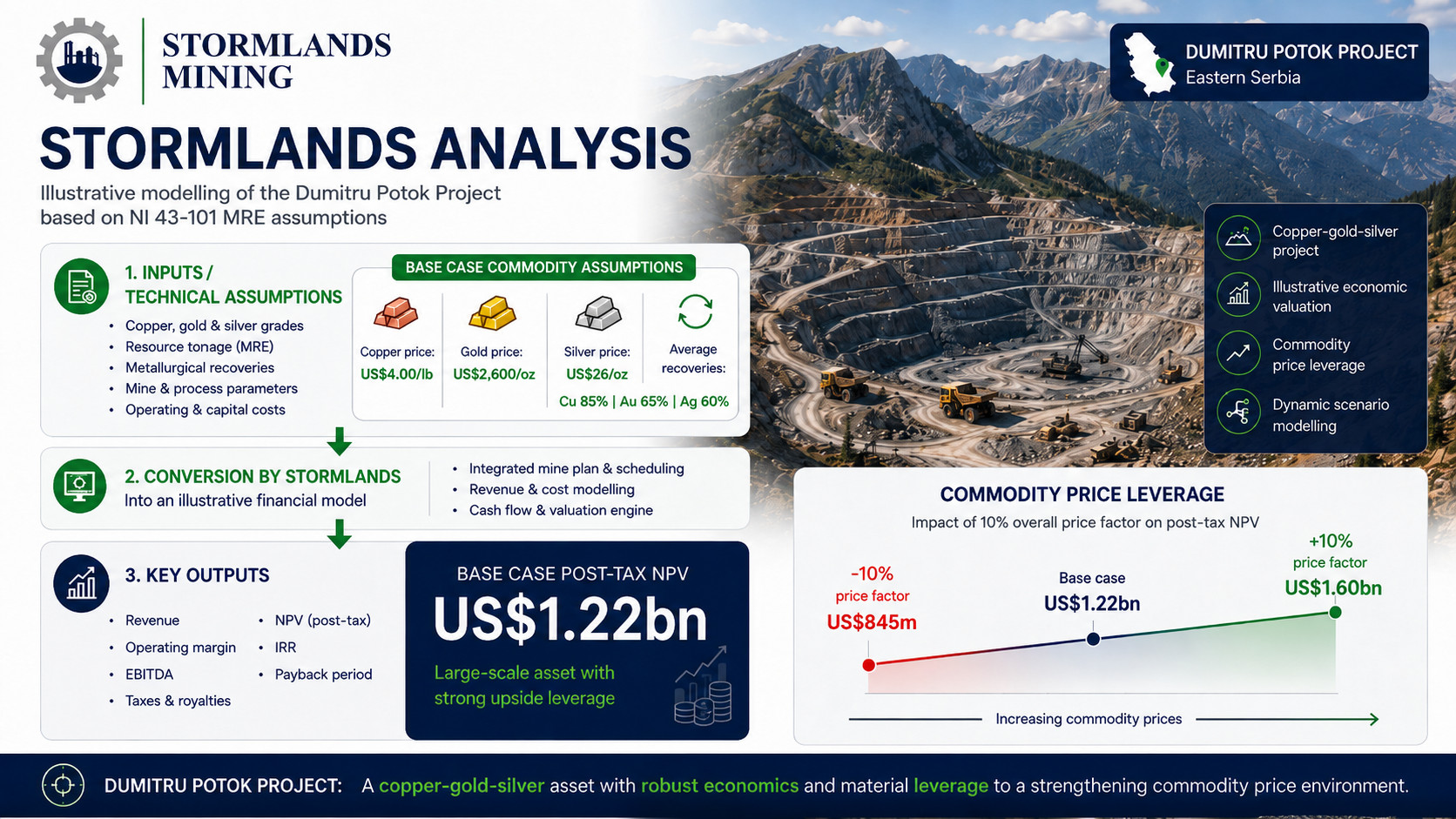
Stormlands’ base case model produces an illustrative post-tax project NPV of US$1.22 billion at a 5% discount rate.
The model also shows:
- Post-tax project IRR of 23.3%
- Payback of 4 years and 3 months
- Mine life of 35.8 years
- Life-of-mine revenue of US$10.1 billion
- Life-of-mine EBITDA of US$4.87 billion
- Life-of-mine corporate income tax of US$583 million
- Life-of-mine government royalties of US$501 million
These are Stormlands model outputs. They are not published economics from the NI 43-101 report and should not be presented as a PEA, PFS or DFS.
Stormlands Analysis
Stormlands’ modelling highlights Dumitru Potok as a copper-gold-silver project with substantial leverage to the commodity price environment.
The base case is built around the NI 43-101 MRE assumptions, including copper, gold and silver grades, resource tonnes, metal prices and NSR reporting assumptions. The technical report reports a total Inferred Mineral Resource of 84.4 million tonnes grading 1.02% copper, 0.97 g/t gold and 6.16 g/t silver. The MRE is reported using metal prices of US$4/lb copper, US$2,600/oz gold, US$26/oz silver and US$2,800/t zinc.
Stormlands then converts those inputs into an illustrative financial model including revenue, operating margin, EBITDA, tax, royalties, NPV, IRR, payback and cut-off grade metrics.
Under the base case, Dumitru Potok generates an illustrative post-tax NPV of US$1.22 billion. The sensitivity analysis shows that a 10% reduction in the overall price factor reduces NPV to approximately US$845 million, while a 10% increase raises NPV to approximately US$1.6 billion.
That range shows the project’s price leverage. Dumitru Potok is not simply a static copper-gold-silver resource. Its implied valuation changes materially as the price deck changes.
Key Highlights
Base case NPV of US$1.22 billion
Using the MRE-based technical assumptions, the Stormlands model produces an illustrative post-tax NPV of US$1.22 billion and an IRR of 23.3%.
Updated commodity prices materially increase value
Under the updated March 2026 commodity-price scenario, project NPV increases from US$1.22 billion to US$3.60 billion. That is an uplift of approximately US$2.37 billion, or around 195%.
Project returns improve significantly under stronger metals prices
The updated price scenario increases IRR from 23.3% to 56.9%.
Payback improves from 4 years and 3 months to 1 year and 9 months
Stronger commodity prices do not just increase NPV. They also shorten capital recovery and materially change the risk-reward profile.
Revenue and EBITDA uplift are substantial
Life-of-mine revenue increases from US$10.1 billion to US$16.8 billion. Life-of-mine EBITDA increases from US$4.87 billion to US$11.23 billion.
Uplift driven purely by price
This shows the power of dynamic modelling: the technical report remains the same, but the economic interpretation changes.
The upside benefits government as well as investors
Higher metal prices increase estimated life-of-mine corporate income tax from US$583 million to US$1.54 billion.
Government royalties increase from US$501 million to US$835 million
Higher commodity prices increase the value flowing to government as well as to project owners and investors.
Dumitru Potok has strong copper and gold exposure
The sensitivity analysis shows that the project is most exposed to the overall commodity price environment. Copper is a major individual value driver, but gold also has a material effect on valuation. This is important because Dumitru Potok should not be viewed only as a copper project. Gold makes a significant contribution to value and becomes especially important under the updated commodity-price scenario.
Silver increases sharply in price but remains less important to total valuation
Silver price sensitivity is positive, but it is not a major driver of overall project value compared with copper, gold, price factor and operating cost.
Stormlands creates an economic model where no economic analysis previously existed
The Dumitru Potok case study demonstrates one of the core uses of the Stormlands platform: creating a structured, auditable, illustrative economic model from a technical report that does not itself contain project economics.
Value Drivers
1. Price factor
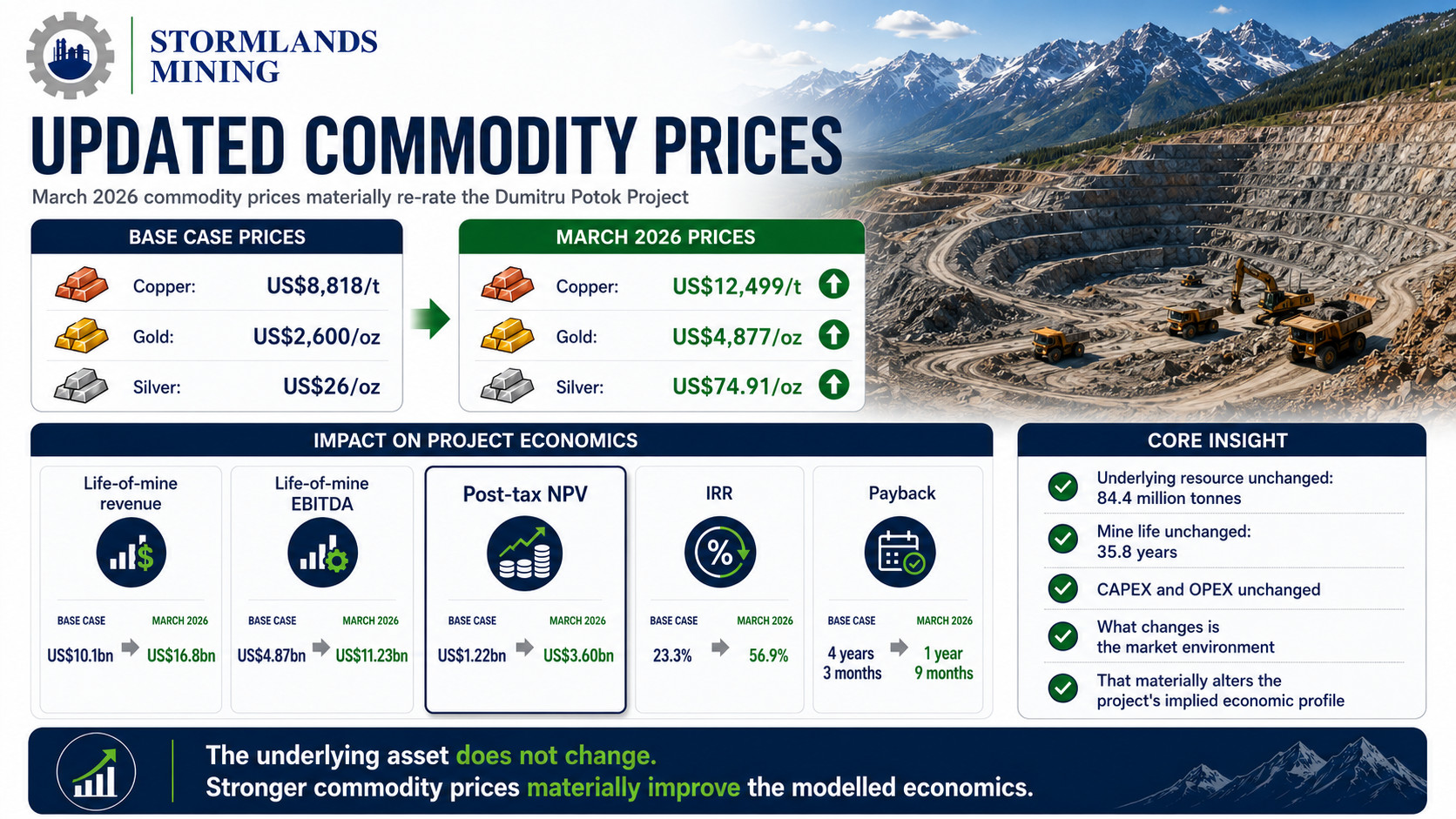
The strongest value driver in the Stormlands model is the overall commodity price factor. A 10% decrease in the overall price factor reduces NPV to US$845 million. A 10% increase raises NPV to US$1.6 billion. This is a swing of roughly US$755 million around the base case. Dumitru Potok is highly exposed to the commodity price environment. The same tonnes and grades produce materially different valuation outcomes depending on the price deck applied.
2. Copper price
Copper is a major individual metal price driver. A 10% reduction in copper price reduces NPV to US$1.0 billion, while a 10% increase lifts NPV to US$1.4 billion. This confirms that Dumitru Potok has strong copper leverage. Copper is one of the central drivers of valuation, although it does not act alone.
3. Gold price
Gold is also a meaningful value driver. A 10% reduction in gold price reduces NPV to US$1.1 billion, while a 10% increase raises NPV to US$1.4 billion. This is an important modelling insight. Dumitru Potok is often framed as a copper-gold-silver project, and the Stormlands model shows that gold is not a marginal by-product. It makes a material contribution to total value.
4. Operating cost
Operating cost is an important controllable driver. A 10% increase in operating cost reduces NPV to US$1.04 billion, while a 10% reduction increases NPV to US$1.3 billion.
5. Capital cost
Capital cost has a moderate effect on valuation. A 10% increase in capital cost reduces NPV to US$1.1 billion, while a 10% reduction increases NPV to US$1.3 billion. This indicates that development CAPEX is important, but the project’s value is not driven by capital cost alone.
6. Discount rate
The discount-rate sensitivity is material, but it is not the principal valuation driver. A 10% reduction in the discount-rate factor increases NPV to US$1.3 billion, while a 10% increase reduces NPV to US$1.2 billion. This shows that the timing and risk profile of future cash flows matter, but the model remains more sensitive to commodity prices than to discount-rate changes.
7. Silver price
Silver has limited impact on total project value. A 10% change in silver price produces only a small movement in NPV, with the model remaining close to the base case. This is an important modelling insight. Dumitru Potok is a copper-gold-silver project geologically, but not all metals contribute equally to value. The model helps separate headline polymetallic disclosure from the actual economic drivers.
Heatmap
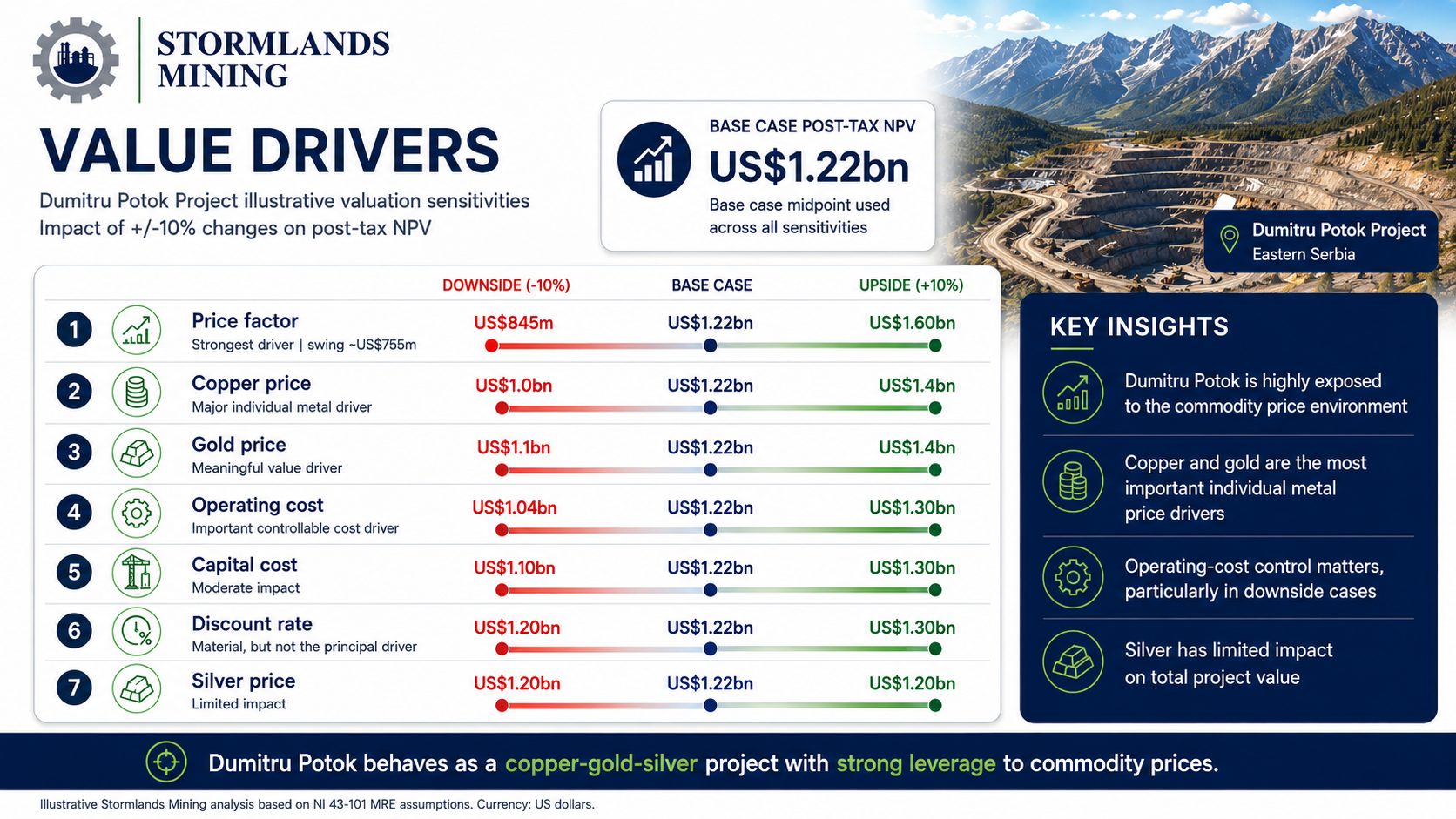
Stormlands’ heatmap across price and operating cost shows the combined impact of changes to commodity prices and operating costs on project NPV.
The model remains positive across the tested matrix, but the range of outcomes is wide. At the low end, a combination of weaker prices and higher operating costs reduces NPV to approximately US$124 million. At the high end, stronger prices combined with lower operating costs increases NPV to approximately US$2.3 billion.
This is a powerful case-study output because it shows that the question is not simply whether Dumitru Potok has a single project value. The better question is how the valuation behaves under changing market and cost conditions.
The heatmap reinforces three conclusions:
- First, commodity prices are the largest driver of value.
- Second, operating-cost control remains important, particularly in downside cases.
- Third, dynamic scenario modelling helps users understand the range of possible outcomes rather than relying on a single static number.
For an early-stage project without a PEA, this is especially useful. It gives project teams a way to frame the key economic questions before committing to more detailed technical and engineering studies.
Updated commodity prices
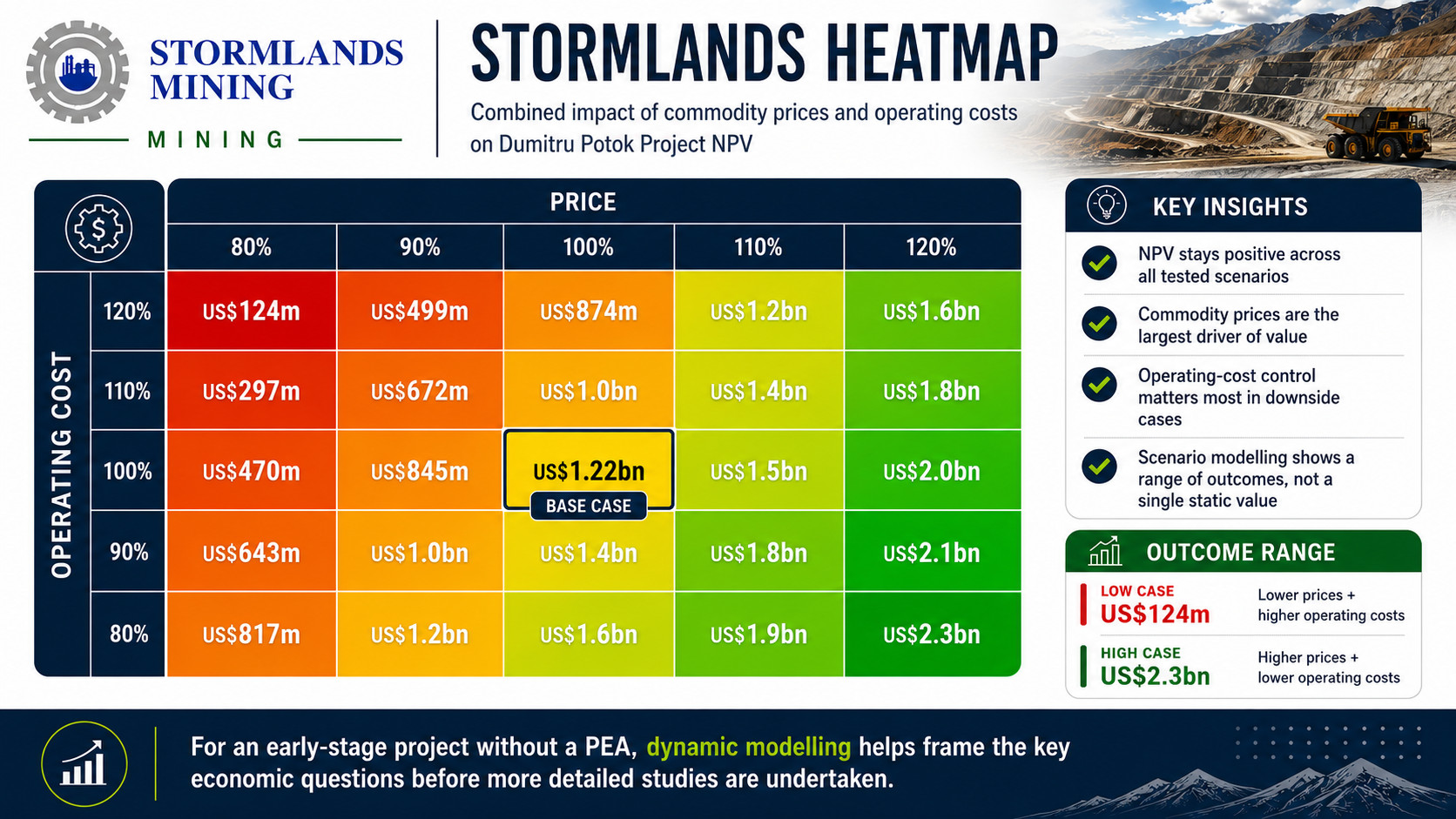
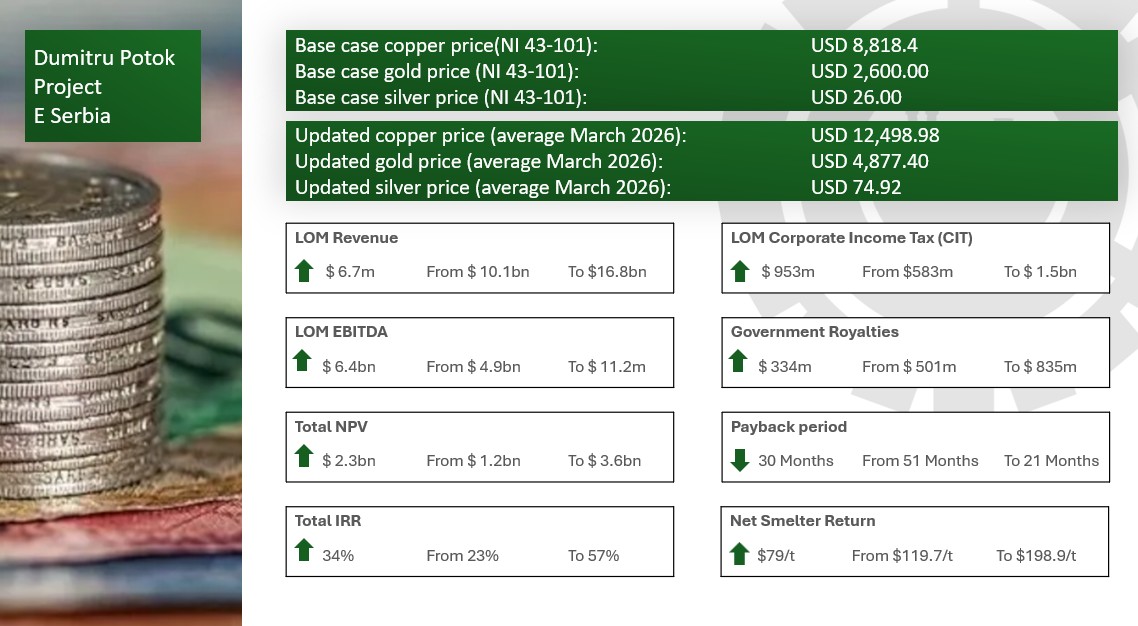
The updated commodity-price scenario is the most striking result of the Dumitru Potok analysis.
The base case uses:
- Copper: US$8,818/t
- Gold: US$2,600/oz
- Silver: US$26/oz
Stormlands then applies March 2026 commodity prices:
- Copper: US$12,499/t
- Gold: US$4,877/oz
- Silver: US$74.91/oz
Under this updated price scenario:
- Life-of-mine revenue increases from US$10.1 billion to US$16.8 billion.
- Life-of-mine EBITDA increases from US$4.87 billion to US$11.23 billion.
- Post-tax NPV increases from US$1.22 billion to US$3.60 billion.
- IRR increases from 23.3% to 56.9%.
- Payback improves from 4 years and 3 months to 1 year and 9 months.
This is the core insight from the Dumitru Potok case study. The underlying resource does not change. The modelled ore body size remains 84.4 million tonnes. The mine life remains 35.8 years. CAPEX and OPEX are unchanged. What changes is the market environment.
That change materially alters the project’s implied economic profile.
Summary
What the Dumitru Potok case study shows
The Dumitru Potok Project shows what becomes possible when structured mining data is extracted from a technical report and converted into a dynamic valuation model.
The NI 43-101 Mineral Resource Estimate provides the geological and technical base. Stormlands then creates an illustrative economic framework that allows users to ask:
- What is the implied scale of the opportunity?
- What mine life could be supported by the Inferred Resource?
- Which metals drive the valuation?
- How sensitive is the project to copper, gold and silver prices?
- How much do operating costs and capital costs matter?
- How does the valuation change under current commodity prices?
- What happens to tax, royalties and payback?
- Where should future technical work be focused before a formal PEA?
This is the value of the Stormlands approach. It does not turn an MRE into a PEA. It does not remove the need for engineering, metallurgical, geotechnical, environmental or mine-planning work.
But it does create a disciplined, transparent and repeatable way to move from technical disclosure to economic questions.
Conclusion
Stormlands’ illustrative model of the Dumitru Potok Project shows a copper-gold-silver project with meaningful economic sensitivity to commodity prices.
Under the base case, the model produces an illustrative post-tax NPV of US$1.22 billion, IRR of 23.3%, and payback of 4 years and 3 months.
Under the March 2026 commodity-price scenario, NPV increases to US$3.60 billion, IRR improves to 56.9%, and payback shortens to 1 year and 9 months.
The sensitivity analysis and heatmap show that Dumitru Potok is most exposed to the overall price deck, with copper and gold acting as the most important individual metal price drivers. Operating cost, capital cost and discount rate also influence value, while silver has a more limited impact on total valuation.
The broader insight is more important than the individual numbers.
Dumitru Potok demonstrates how Stormlands can take a Mineral Resource Estimate and create an illustrative economic model before a formal PEA exists. This gives analysts and project teams a way to test scenarios, understand value drivers and identify the technical assumptions that matter most.
For early-stage mining projects, this is where dynamic modelling can add real value: not by replacing formal technical studies, but by helping decision-makers understand which questions should be asked next.
About Stormlands
Stormlands Mining is an AI-first valuation and analytics platform for mining assets and critical minerals. The platform enables users turn technical disclosures into interactive valuation models in minutes, rather than days or weeks. The valuation models are accessible over multiple platforms to all users, enabling the user to interact directly with the data to facilitate scenario-planning.
The platform enables users to build discounted cash flow models at scale, test commodity price, capex, opex, tax, royalty rates, discount-rates and production scenarios, and compare opportunities and scenarios.
Stormlands is using its technology to build the Stormlands Library: a global repository of mining asset valuation models. It has moved beyond a tool for analysts building individual models and is developing a data layer for the mining industry: a structured source of valuation models and illustrative scenarios. This creates a new way for investors and stakeholders to screen assets, benchmark projects and understand the key drivers of mining asset economics.
Disclaimer
This analysis has been prepared by Stormlands Mining using publicly available information from the NI 43-101 Technical Report and Mineral Resource Estimate for the Dumitru Potok, Frasen and Rakita North prospects in Eastern Serbia, together with Stormlands’ own independent modelling assumptions.
The analysis is illustrative only. It is not a Preliminary Economic Assessment, Pre-Feasibility Study, Feasibility Study, Mineral Reserve estimate or independent technical report. It has not been prepared on behalf of the project owner and has not been reviewed or approved by the project owner.
The model outputs are Stormlands-generated illustrative estimates only. They should not be interpreted as demonstrated economic viability. Mineral Resources that are not Mineral Reserves do not have demonstrated economic viability. Future technical work, including mine planning, metallurgical testing, engineering, environmental studies, permitting, capital-cost estimation and operating-cost estimation, would be required before any formal economic conclusions could be drawn.
More information
Download the full DPM Dumitru Potok case study
View Dumitru Potok Project on YouTube