
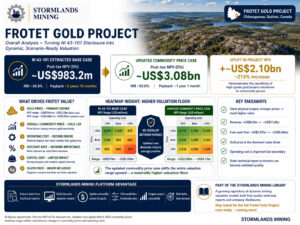
Using data extracted from the NI 43-101 Technical Report effective date 30 November 2025 for the Regnault Deposit, Stormlands developed an illustrative economic model generating a post-tax project Net Present Value (NPV) of US$983.2 million at a 5% discount rate, with a post-tax Internal Rate of Return (IRR) of 35% and a payback period of 2 years and 10 months.
Illustrative scenario shows how Frotet Gold Project economics may respond to March 2026 commodity prices
Dublin, Ireland — [29 June 2026] — Stormlands Mining has published a new case study on the Frotet Project’s Regnault Deposit in Québec, Canada, demonstrating how a publicly available NI 43-101 Technical Report can be converted into a dynamic economic valuation model, even in the absence of an Economic Assessment.
Using data extracted from the NI 43-101 Technical Report effective date 30 November 2025 for the Regnault Deposit, Stormlands developed an illustrative economic model based on the published mineral resource, metallurgical information and technical disclosure.
The Stormlands base case model generates a post-tax project Net Present Value (NPV) of US$983.2 million at a 5% discount rate, with a post-tax Internal Rate of Return (IRR) of 35% and a payback period of 2 years and 10 months.
The model also generates:
- Life-of-mine revenue of US$6.0 billion
- Life-of-mine EBITDA of US$3.47 billion
- Life-of-mine post-tax free cash flow of US$1.87 billion
- Initial capital requirement of US$300 million
Stormlands then updated the model using March 2026 commodity prices while holding all other core assumptions constant, including mine life, production schedule, recoveries, operating costs, capital costs and fiscal assumptions.
Under this updated commodity price scenario, project NPV increases to US$3.08 billion, representing an increase of US$2.10 billion, or 213%, compared with the base case.
Project IRR increases from 34.8% to 92.6%, while payback improves from 2 years and 10 months to 1 year and 1 month.
Life-of-mine revenue increases from US$6.0 billion to US$11.8 billion. Life-of-mine EBITDA increases from US$3.47 billion to US$8.99 billion, while life-of-mine free cash flow increases from US$1.87 billion to US$5.46 billion.
The underlying resource, mine life, production profile, capital costs and operating costs remain unchanged between the two scenarios.
The uplift is therefore driven entirely by commodity prices.
Margin Expansion
- The discounted cash flow comparison shows that stronger commodity prices materially improve project margins.
- Life-of-mine EBITDA increases from US$3.47 billion to US$8.99 billion.
- Operating margin increases from US$256 per tonne to US$652 per tonne, while operating margin percentage increases from 61.7% to 80.4%.
- This means that the same physical mine plan generates substantially higher profitability without any change to mining or processing assumptions.
Value Drivers
- Stormlands’ sensitivity analysis shows that gold price is overwhelmingly the dominant driver of project value.
- In the base case model, 10% fluctuation in gold price pushes the project NPV range to US$766 million and US$1.20 billion.
- In the updated commodity price model, 10% fluctuation in gold price pushes the project NPV range to US$2.66 billion and US$3.50 billion.
- The overall commodity price factor produces almost identical results, confirming that the project behaves economically as a gold project.
- Operating cost is the second most important value driver, while discount rate has a moderate influence on valuation.
- Capital cost sensitivity is relatively limited, reflecting the project’s strong margins and moderate initial capital requirement.
- Silver contributes additional revenue but has minimal influence on overall valuation, confirming that the investment case is overwhelmingly driven by gold.
Heatmap Analysis
- The price and operating cost heatmap, modelling 20% increase and decrease in price and operating cost, provides one of the strongest insights from the Frotet case study.
- Under the base case model, NPV ranges from US$370 million in the downside scenario of 20% lower commodity prices and 20% higher operating costs. A 20% increase in commodity prices and decrease in operating costs push the base case NPV to US$1.60 billion.
- The heatmap demonstrates that the project remains positive across all tested scenarios.
- It also shows that commodity prices have substantially greater influence on valuation than operating costs.
- Importantly, the updated commodity price scenario does not simply improve the base case. It shifts the entire valuation range upward.
- Even the most conservative scenario in the updated commodity price heatmap generates a higher valuation than many development-stage gold projects achieve under base case assumptions.
Economic Resilience
- One of the most important findings from the case study is the project’s resilience.
- Even under scenarios combining lower commodity prices and higher operating costs, the model continues to generate substantial positive value.
- This suggests that the project’s economics are supported not only by commodity prices but also by the combination of high grades, strong margins and moderate capital intensity.
The Frotet model forms part of the Stormlands Mining Library, a growing repository of mining asset valuation models built from public technical reports and company disclosures.
The Library is designed to help investors, mining companies, banks, advisers and other stakeholders understand the key drivers of mining asset economics.
The Frotet Project is owned by Sumitomo Metal Mining Canada Ltd. and Kenorland Minerals Ltd. Stormlands modelled the project using public technical disclosure and independent analysis.