
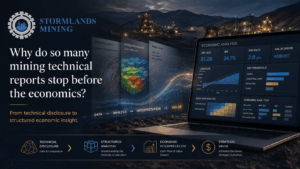
At Stormlands Mining, we have been modelling TSX-listed mining technical reports as part of our broader work to build structured valuation models for global mining assets and projects. One thing stands out:
A significant percentage of technical reports do not include a project-level economic analysis.
In our current review, approximately 40% of the reports modelled do not provide an economic analysis. That raises an important question:
Why?
There are two obvious explanations.
First: some reports relate to assets already in production. In those cases, companies are often not required to publish a fresh economic analysis in the same way as a development-stage project.
Second: some reports are earlier-stage mineral resource reports, exploration updates or technical updates where no formal project economics are provided.
That may explain part of the gap but it does not explain all of it. In our review, a meaningful number of reports with no economic analysis relate to pre-production projects with mineral resource estimates. That is where the question becomes much more important:
Why is this extremely important task not being completed?
The absence of economic analysis creates a major gap between geological disclosure and investment decision-making. A technical report may give us tonnes, grade, contained metal, cut-off grade, resource classification, mining method, processing assumptions and recovery assumptions. The cut-off grade is not just a technical number, it is an economic boundary. It already contains a series of economic assumptions, including metal price, recovery, operating cost, royalties, payability, dilution, mining recovery and exchange rates. Sometimes these assumptions are visible. Sometimes they are buried in tables. Sometimes they are only partially explained. But if the report is already using economic assumptions to define what is potentially economic, why does the analysis often stop there?
Why do we get a cut-off grade, but not a valuation model?
Why do we get contained metal, but not project-level economics?
Why do we get a resource statement, but not an estimate of capital intensity?
Why do we get tonnes and grade, but not an estimate of future government revenues?
For investors, this matters. A copper project with excellent grade may still struggle if capital intensity is too high. A gold project with strong contained ounces may still produce weak returns if sustaining capital is underestimated. A polymetallic project may look attractive on a copper equivalent basis, but the revenue mix, payability, penalties, recovery assumptions and concentrate terms can completely change the economics.
For economic geologists, this matters too. A deposit is not just a collection of tonnes and grade. It is a potential business. Resource geometry, grade distribution, strip ratio, recovery, mining selectivity and metallurgical performance all flow directly into economic outcomes.
For junior explorers and project promoters, this may matter most of all. If a project is being presented to investors, strategic partners, governments, lenders or potential acquirers, the missing question is not only:
“Is there a resource?”
It is:
Could this project be economically viable?
Will it provide an acceptable return for investors?
Will it be financially sustainable?
The answer to these questions requires structured thinking.
What is the likely scale of capital expenditure?
What level of sustaining capital might be required?
What operating margin is implied?
What fiscal regime applies?
What government revenue might be generated?
What commodity price is needed to justify development?
What happens if recoveries are lower?
What happens if capex is 30% higher?
What happens if royalties or taxes change?
These are not academic questions. They are the questions that determine whether a mineral asset can attract capital.
At Stormlands, we believe this gap is becoming increasingly important. The industry has made enormous progress in technical disclosure. Resource reporting is more structured. Technical reports are highly detailed. But economic interpretation remains inconsistent. That creates a problem. Investors are left trying to translate technical reports into financial models manually. Junior explorers and project promoters are left trying to explain value using static presentations. Governments are left trying to understand future tax, royalty and state revenue without a consistent project-level model, and economic geologists are often left with their work being judged through overly simplified metrics.
The real question is:
What does the asset actually support economically?
This is the question Stormlands is answering. We are building structured, auditable valuation models from public technical reports, including reports that do not contain formal economic analysis. That means taking the technical information already disclosed and using it to create scenario-ready models that can estimate or benchmark:
- capex
- sustaining capital
- operating cost structure
- revenue by commodity
- royalties and taxes
- government take
- NPV and IRR sensitivity
- payback
- valuation impact of commodity prices, recoveries, costs and fiscal terms
But the bigger opportunity is not only to model individual reports, it is to build a structured, algorithmic and predictive valuation system for mining assets. Every technical report modelled adds to the dataset. Late-stage exploration projects, PEAs, pre-feasibility studies and definitive feasibility studies all contain useful information about tonnes, grade, recoveries, mining methods, processing routes, capital intensity, operating costs, sustaining capital, fiscal terms and valuation outcomes. Producing mines add another layer. Where actual capex, sustaining capital, operating costs and production performance can be observed, inferred, benchmarked or validated from producing assets, they help improve the logic for estimating missing economic information.
That matters because the industry has a major data problem. A pre-production project may disclose a mineral resource, a cut-off grade and some technical assumptions, but not a full economic model. A producing mine may disclose production and operating results, but not a fresh project-level valuation. A DFS may contain detailed economics, but those assumptions are often locked inside static documents and are difficult to compare systematically with other assets.
Stormlands connects those dots. By structuring this information across many assets, commodities, jurisdictions and development stages, we can start to benchmark and estimate the missing economic pieces more intelligently. The objective is not to pretend that incomplete information is complete. The objective is to make the uncertainty visible, testable and comparable. That is the real opportunity: to move from static technical disclosure to dynamic economic interpretation, and, over time, to build predictive tools that help investors, project promoters, governments and technical teams understand what a project could reasonably support economically.
This does not replace formal technical studies. It does not replace the role of the Qualified Person. It does not turn every mineral resource into a mineral reserve. But it does make the economic question visible much earlier. The mining sector does not lack technical information – it lacks consistent economic interpretation of that information.
So the questions we keep asking are:
Why should economic analysis only appear at certain formal study stages?
Why should investors wait until late in the process to understand a project’s potential value?
Why should governments wait to understand future revenue potential?
Why should project promoters leave value unexplained?
If a technical report contains enough information to define a cut-off grade, then it already contains the beginning of an economic story. At Stormlands, we think that story should be modelled, tested and made visible. Because in mining, the real question is not only what is in the ground.
It is whether what is in the ground can become a mine worth building.