
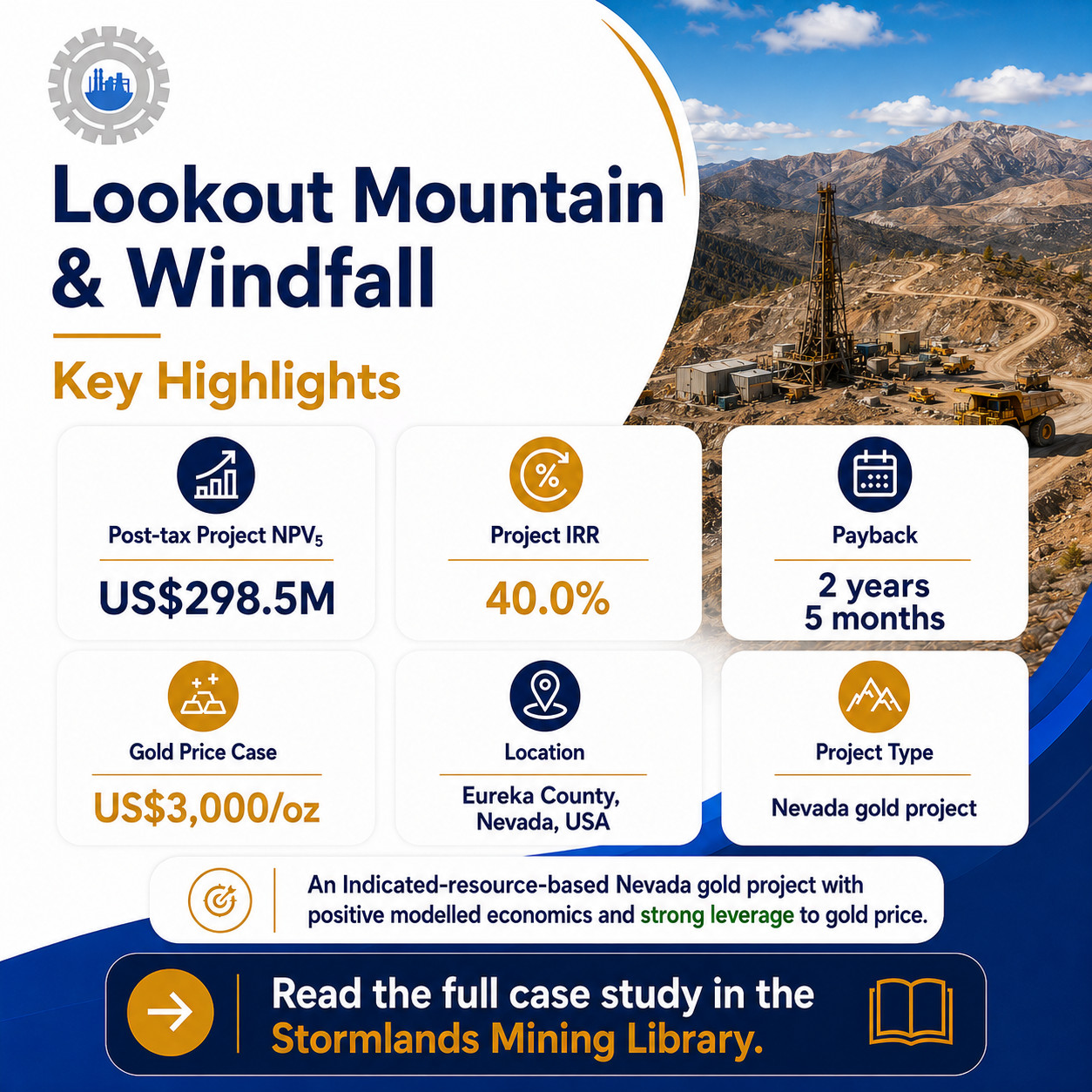
Illustrative model establishes post-tax NPV of US$298.5 million and shows current gold price more than doubles NPV to US$632.3 million.
Stormlands Mining has published a new independent case study on the Lookout Mountain and Windfall gold deposits in Eureka County, Nevada, USA.
Using data from the 2026 NI 43-101 Technical Report on the Mineral Resources Estimate (effective date 4 May 2026) for the McEwen Inc Lookout Mountain and Windfall deposits, together with independent mine-life, capital and operating-cost assumptions, Stormlands developed an illustrative discounted cash flow model.
The model also generates:
- Life-of-mine revenue of US$1.473 billion
- Life-of-mine EBITDA of US$766.8 million
- Post-tax project free cash flow of US$440.4 million
- AISC of approximately US$1,767/oz
- Modelled mine life of 9.2 years
- Initial capital of US$150.0 million
Full case study published here: https://www.stormlandsmining.com/library/lookout-windfall/
Updated gold-price scenario
Stormlands then created an updated scenario using a gold price of US$4,245.22/oz (average of June 2026) while holding the physical plan and core cost assumptions constant, including resource tonnes and grade, recovery, production profile, mine life, operating costs, capital costs and the 5% discount rate.
Under the updated-price scenario, Project NPV increases from US$298.5 million to US$632.3 million, an increase of approximately US$333.9 million, or 111.9%. Project IRR rises from 40.0% to 72.8%, while modelled payback shortens from two years and five months to one year and five months.
Life-of-mine revenue increases from US$1.473 billion to US$2.084 billion. Life-of-mine EBITDA increases from US$766.8 million to US$1.351 billion, and post-tax project free cash flow increases from US$440.4 million to US$887.1 million.
The underlying physical plan does not change between the two scenarios. The uplift is driven by applying the higher gold price to the same illustrative resource, production and cost framework.
Gold price is the dominant value driver
The sensitivity analysis, which ranks value drivers, identifies gold price as the dominant individual value driver. The tested gold-price range (+/-10%) moves Project NPV from US$218 million to US$379 million, a range of about US$161 million. Operating cost is the principal controllable factor, producing an NPV range of about US$71 million, while capital cost and discount rate have materially smaller effects within the ranges tested.
The two-variable heatmap tests gold price and operating cost simultaneously from 80% to 120% of their base assumptions. Project NPV remains positive in all 25 tested combinations, ranging from approximately US$66.7 million in the most adverse tested case to US$530 million in the most favourable tested case.
At base operating cost, moving gold price from 80% to 120% changes NPV from approximately US$138 million to US$459 million. At base gold price, moving operating cost from 120% to 80% changes NPV from approximately US$228 million to US$369 million. On a percentage-for-percentage basis, the model indicates that gold price has approximately 2.3 times the NPV impact of operating cost.
Margin expansion and early cash generation
The updated current gold-price scenario materially increases the value generated by each modelled tonne while the operating-cost assumption remains unchanged at US$21.39/t processed. Net smelter return increases from US$50.83/t to US$71.93/t, while cash operating margin increases from US$29.44/t to US$50.54/t.
The DCF comparison also shows that the increase in value is front-loaded. Approximately 48.8% of the total NPV uplift is generated in the first four operating years and approximately 69.8% in the first six. In a normal full operating year, post-tax Project FCFF increases from approximately US$65.9 million to US$114.2 million.
The stronger early cash-flow profile improves capital recovery and reduces reliance on distant, more heavily discounted cash flows.
Róisín O’Connell, CEO of Stormlands Mining, said
“Mining has spent decades standardising how resources are reported, but not how the economic information inside technical reports is converted into usable data. That leaves investors and project teams comparing PDFs, assumptions and spreadsheets that were never designed to speak the same language. AI has the capacity to change that. Its real value is not summarising another 200-page report; it is extracting, structuring and standardising the underlying technical data so the economics of an asset can be tested transparently and consistently. Lookout Mountain and Windfall show what becomes possible once that data layer exists: a Mineral Resource Estimate with no published PEA can be translated into an illustrative valuation framework, the principal value drivers can be ranked, and the impact of a different gold-price environment can be measured without changing the geology or mine plan. The next leap in mining analytics is a common, auditable data standard that makes technical disclosure decision-ready.”
– ENDS –